
As a team, you have established a basic support routine for your community platform. Now you are ready to scale and to actually start doing the community thing.
But how can you scale up when you can’t hire more moderators and community managers? And how can you make your platform inviting so that it really becomes a community?
Scale support through peer-to-peer help
You start helping your users to help themselves and each other:

Aim to make yourself redundant
when it comes to support and service
Your goal is to freeing up your limited resources. So you aim to make yourself redundant as support and service moderators.
You will never get there. There will always be a need for individual support. But you can go a long way when you scale your moderation and let peer-to-peer support evolve.
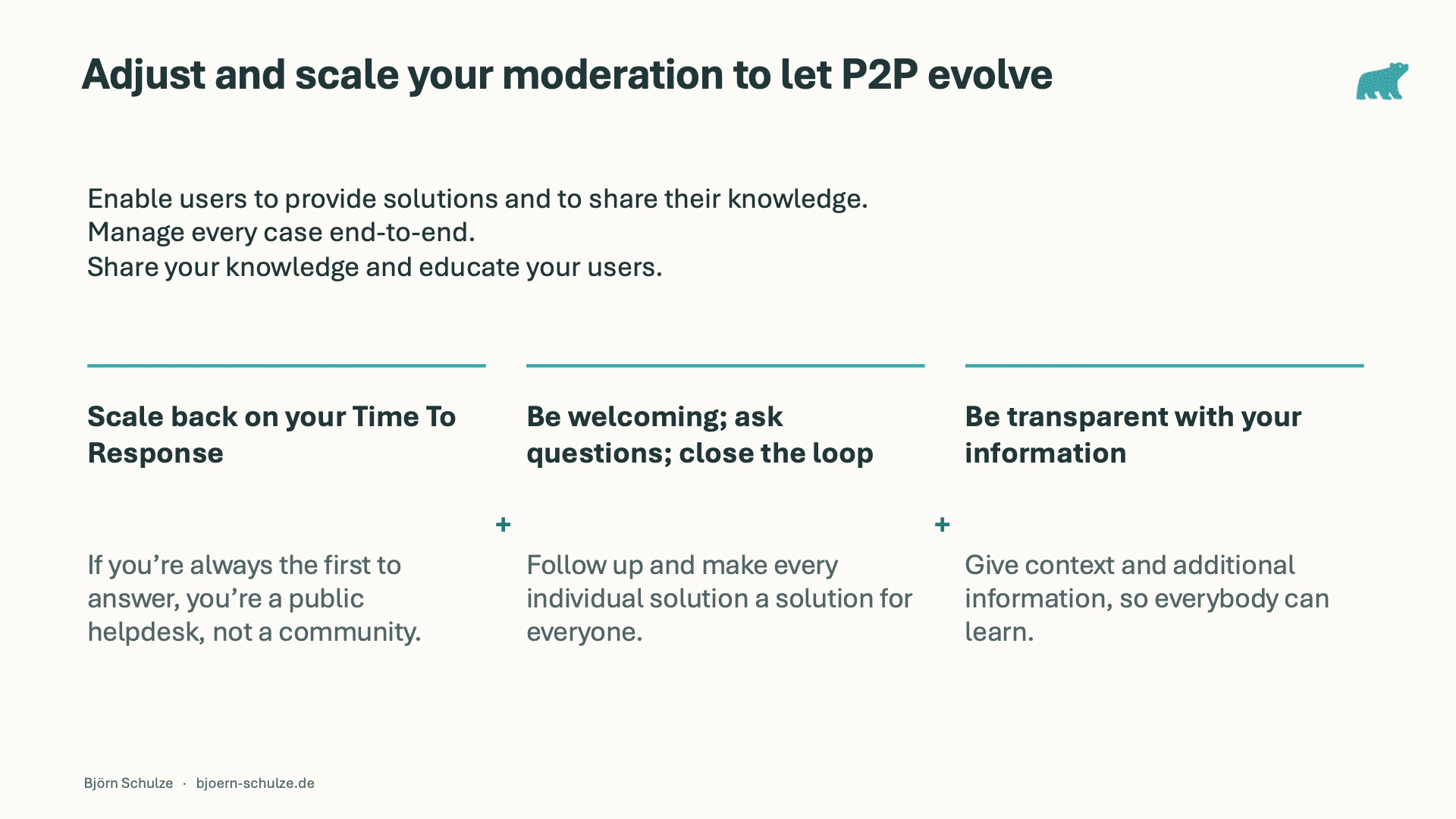
To achieve this, empower your users to provide solutions and encourage them to share their knowledge. Do this by sharing your expertise, by staying accountable, and by creating space for meaningful peer-to-peer interactions.
Create space
If you’re always the first to respond to a topic, then you’re a public help desk – but not a community. So, as soon as your community starts to pick up pace, it’s time for you to adjust your own response times.
Be accountable
Then it’s important to ask questions, to give context, and to always close the loop.
If a user resolved their problem on their own, ask them to share their solution with the community. If you need to pull a conversation to private messages, post a public follow-up to let everyone know how the issue was solved.
Share your expertise
Always be open and transparent with your information. Every solution you give, every follow-up question you ask, every additional information you provide, isn’t just aimed at the person asking the question. It’s also aimed at everyone who will ever read the topic. The more you give, the more your users can learn.
And eventually the users will ask those follow-up questions themselves. They will provide the solutions themselves. They will link to additional information themselves. So you don’t have to anymore.
Next Step: Dive into how to scale back on your response times and how to develop processes and workflows to enable both excellent service and peer-to-peer engagement.