
In your community, you have adjusted and scaled your moderation to let peer-to-peer support evolve. Now it’s time to scale back on your response times.
A few years ago, one community suddenly received many new users and questions. At the peak, almost 5,000 new questions arrived in a month. The backlog grew, and the team could no longer keep up.
So, we created the Concierge as a new moderator role.
A concierge workflow for incoming questions
While the classic moderation workflow is First-In-First-Out, the Concierge’s job is to monitor the community near real-time. The Concierge needs to make a quick decision based on a few questions:
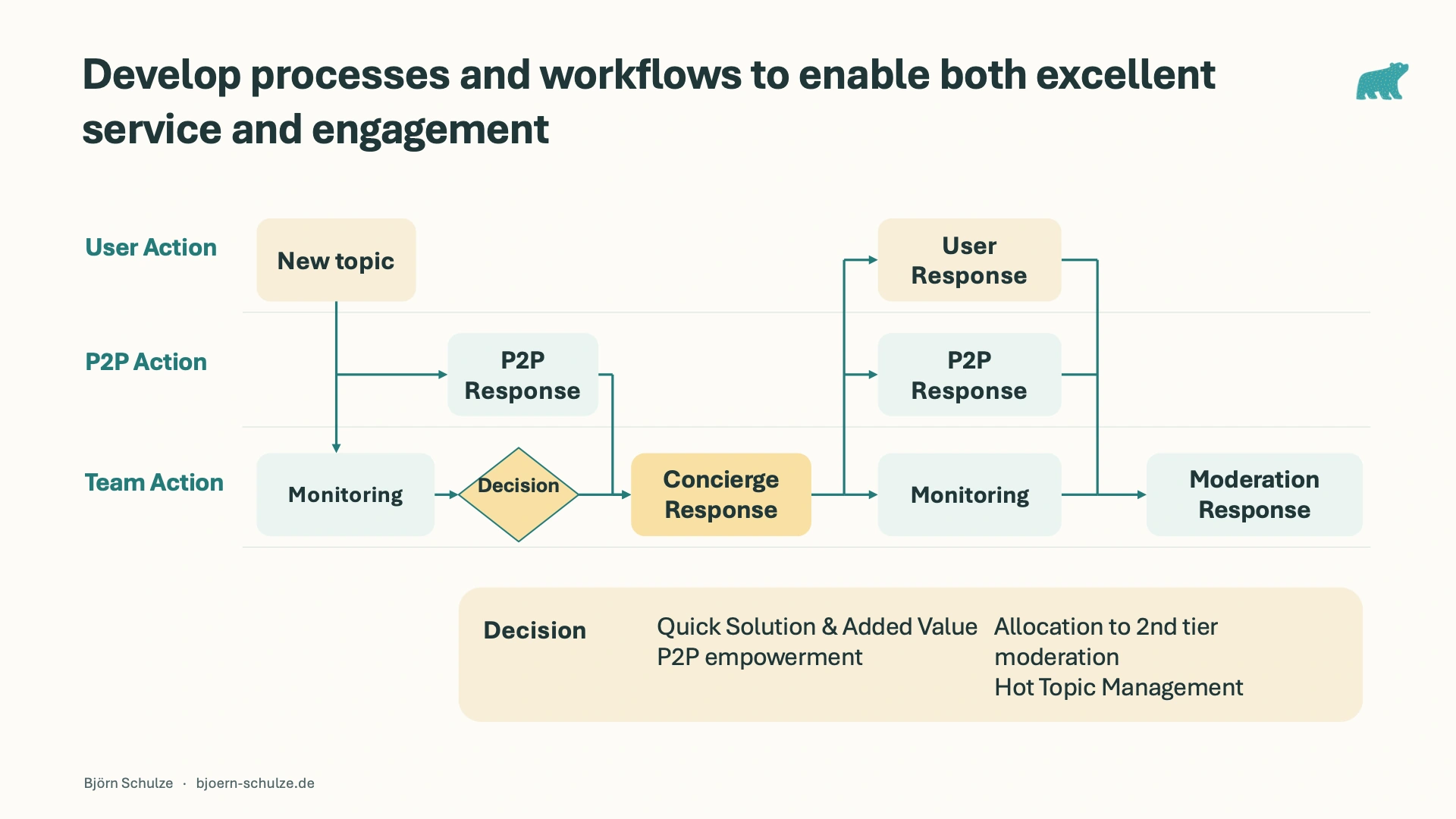
Is the topic and the pain point time-sensitive? Does it have escalation potential? If yes, then the Concierge responds immediately and starts the moderation process now.
Choose the right response
Can the question be answered peer-to-peer? Then the Concierge lets it sit for 24 hours. If after 24 hours the community couldn’t solve it on their own, the moderation teams provides a quick solution with additional information.
Is the topic a customer support issue? Or do you need more information before you can actually help? Then the Concierge responds immediately and asks for more information so your moderation team or the community can take over.
Also – you always try to empower users to give tips and solutions.
You can break down the Concierge role into 3 rules:
- Be welcoming and show early presence – like a Concierge
- Empower peer-to-peer engagement
- Escalate to the classic moderation when you can’t solve it with one quick action
In short: A Concierge can welcome a user, provide support and link to a self-service resource. A follow-up question helps clarify the issue. When the user responds, a conversation develops that other users can join. That is a foundation of community work.
Next step: As peer-to-peer support starts to establish itself, it frees up resources and allows you to extend the scope and start working with the feedback you’re getting.